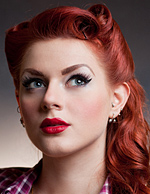
Dru Blair's Portrait 2: Advanced Photorealism Workshop
Developing complex skin tones and textures.
All new for this year, this hands-on workshop covers the
techniques and approaches to photorealistic portrait
painting as seen in the paintings on this page. Realistic
skin texture can be difficult to achieve if you don't know
what to look for and how to reproduce it correctly.
In this advanced Portrait workshop, Dru will demon-
strate his approach to painting convincingly accurate
skin textures, as well as lips, eyes,facial hair, and many
other attributes that make up a well-executed photo-
realistic painting. Students will learn to render skin, hair,
and eye colors with extreme accuracy and precision
using their knowledge of Dru Blair's Color Buffer Theory.
It is recommended that each student have attended at
least one workshop with Dru Blair prior to enrolling in
this advanced Portrait Workshop. There will be no first-
day
morning lecture, so students will have more time to
work on their projects.
The Portrait 1 workshop is usually held one week before
the advanced Portrait 2 workshop for those who wish to
take back-to-back classes. There is a discount for
enrollment in both workshops. Advanced class is 5 days.
. There will also be
no Foundations class before this
workshop.
Class is limited to 12 and will be filled on a first-come,
first-served basis.

Some of the topics covered:
• How to create accurate fleshtones for complex skin
• Mastering and applying skin colors
• Understanding and applying Dru's color buffer theory
• Transparent vs opaque techniques
• How to make and match a transparent skin tone
• How to survive catastrophic painting errors
• Tweaking and controlling problem areas
• Understanding white and the impact it has on your images
• How to match a color perfectly every time
• Where to market and how to price your work
• The 10 rules of Photorealism
• Where to find clients willing to pay you the big bucks
• Advanced techniques with other texture creating tools
• How to really understand light and shadows
• The two most important requirements for photo-realistic paintings
• 21 elements of vision and how applying them allows you to create a photorealistic painting
• How to discern problem areas in your own paintings that might otherwise have gone unnoticed
• How to develop observation techniques that allow you to expand your visual discrimination
• How to make hair look real
• Rendering facial details such as skin texture, hair, lips, and eyes with accuracy
• The single most important thing to remember when negotiating a price for your work
• Buffered contrast reduction ( BCR) - how and when to use it
• Split paper/frisket techniques
• Shield-reveal techniques
• Shield-conceal techniques
• Bounce method
• Eraser techniques
• frisket vs paper
• How and when to use liquid frisket
• Frisket overlap method
• Single color multiplier and when to use it
• The Step method fortransitions
• The Skeet method for texture
• Creating textures through chemistry
|