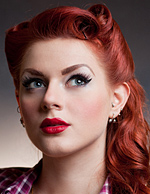
Dru Blair's Photorealistic Portrait Workshop
Photorealistic Portraiture: our most popular course!
Newly updated for 2010, this hands-on workshop covers
the techniques and approaches to portrait illustration as
seen in the paintings on this page. Dru Blair and his staff
will demonstrate the techniques of painting photorealistic
skin tones, hair, lips, eyes, backgrounds, and many other
attributes that make up a well-executed photorealistic
painting. The students will learn to quickly match skin,
hair, and eye colors with extreme accuracy and precision
through
Dru Blair's Color Buffer Theory.
All materials and reference will be supplied in our new
facility, which features color-corrected lighting and a
state-of-the-art air filtration system. There will also
be an optional
Foundations class that will be held on the
Wednesday before each workshop for those wanting to
brush up on their airbrush control.
Although portrait painting may seem formidable, this
workshop is non-intimidating with both the novice and
veteran artist in mind.
Class is limited to 16 and will be filled on a first-come,
first-served basis. To reserve your seat today, browse
to the
class schedule and select the workshop
date that most fits your schedule.

Some of the topics covered:
• How to create accurate fleshtones
• Mastering color
• Understanding Dru's color buffer theory
• Transparent vs opaque techniques
• Achieving perfect proportions
• How to survive catastrophic painting errors
• Tweaking a lifeless image so that it leaps off the canvas
• Understanding white and the impact it has on your images
• How to match a color dead-on every time
• How to market and price your work
• The nine rules of Photorealism
• Where to find clients willing to pay you the big bucks
• The right tools for the best results
• How to really understand light
• The two most important requirements for photo-realistic paintings
• 21 point photorealism checklist
• How to automatically discern problem areas in your own paintings that might otherwise have gone unnoticed
• How to develop observation techniques that allow you to expand your visual discrimination
• How to make hair look real
• Rendering details such as hair, lips, and eyes with accuracy
• The single most important thing to remember when negotiating a price for your work
• Buffered contrast reduction - how and when to use it
• Split paper/frisket techniques
• Shield-reveal techniques
• Shield-conceal techniques
• Bounce method
• Eraser techniques
• The proper use of frisket
• How to use liquid frisket effectively
• Frisket overlap method
• Single color multiplier and when to use it
• Step method transitions
• Skeet method for creating skin texture
• Creating textures with chemicals